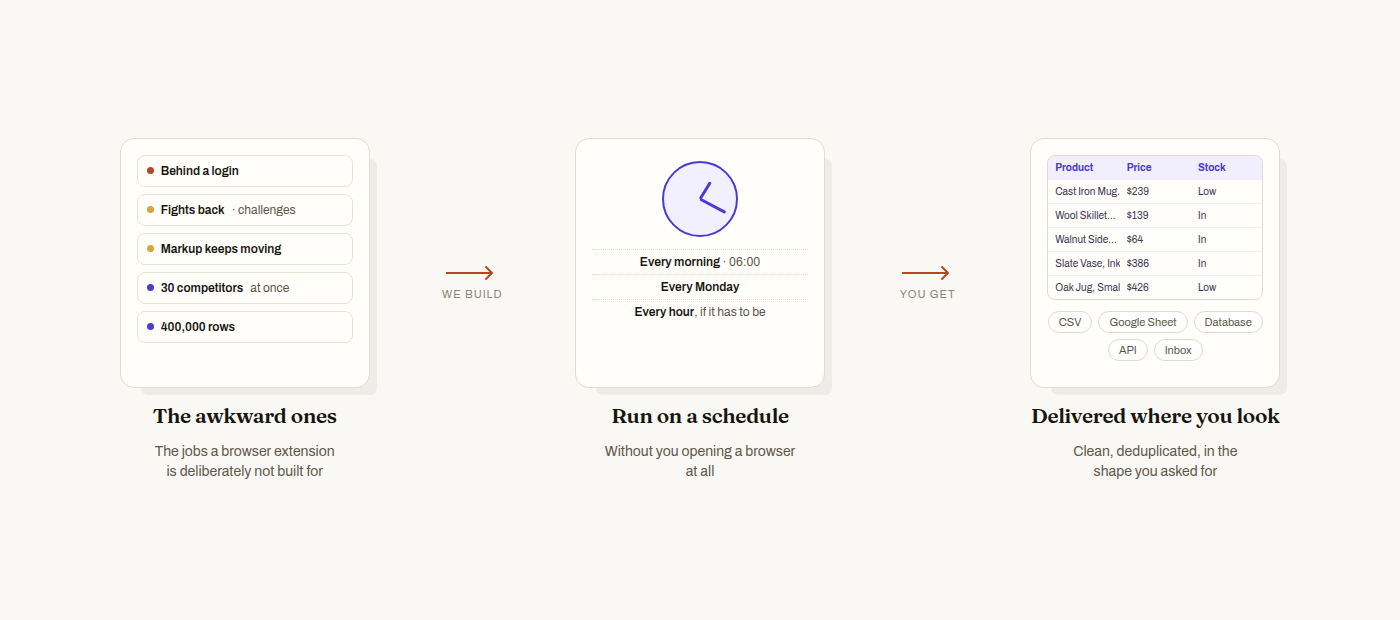
What we take on
The extension is deliberately limited to what your browser has already rendered. These are the jobs on the other side of that line.
Systems you already have access to
Your own dashboards, a supplier portal you are a customer of, an internal tool with no export button. Work we do with your authorisation and your credentials, never around anybody's access controls.
Awkward, fragile sources
Aggressive rate limits, markup that changes shape every few weeks, data that arrives in an inconvenient shape. These need something sturdier than a content script, and monitoring so you hear about a break from us rather than from a blank spreadsheet.
Scrapes on a schedule
Every morning, every Monday, every hour. Prices, stock, listings, jobs, tenders, rankings — anything whose value is that it is current. You stop remembering to run it.
Volume, and many sites at once
Hundreds of thousands of rows. Or the same fields taken from thirty competitors, deduplicated and reconciled into one table with a consistent schema, which is usually the harder half.
Delivered where you actually work
A CSV or Excel file, a Google Sheet that updates itself, rows appended to your database, a JSON endpoint, or a file dropped in S3 or Drive. A report nobody opens is not a deliverable.
One-off rescues
A single list you need this week, cleanly, without learning a tool. Often the cheapest thing on this page.
What to send
Four things. It is usually enough for a yes, a no, or a number.
- The site or sites — a URL. If it needs a login, say so; you don't have to send credentials to get a quote.
- What you need out of it — which fields, and what the finished file or feed should look like. A screenshot of the page with things circled works perfectly.
- How often — once, daily, hourly, or "whenever it changes".
- Your budget and deadline — a figure you have in mind is enough. It tells us immediately whether the scope fits, which saves us both a fortnight of back-and-forth.
Email support@magicscraper.app. Nothing you send is shared with anyone, and quoting costs nothing.
What we'll tell you for free
Including the answers that lose us the job.
If a site can't be collected lawfully or reliably, we say so and explain why. That is worth more to you than the invoice is to us, and it is the reason to ask us rather than whoever said yes to everything.
Whether data may be collected from a given site is a question of that site's terms, its
robots.txt, copyright and database rights, and — where the rows are
about people — data-protection law. We will not build something that bypasses
access controls or that hammers infrastructure to the point of damage.
We'll also tell you when the free extension already does it. Plenty of jobs that feel like projects are ten minutes with the Chrome extension and no invoice at all.
Reasonable questions
What does a project cost?
It depends almost entirely on how hard the site fights and how often it has to run. A single list from a cooperative site is small. A logged-in portal with bot protection, collected hourly and reconciled against two other sources, is not. Tell us the budget you have in mind and we'll tell you honestly whether the scope fits it.
How long does it take?
A one-off extraction is usually days rather than weeks. A scheduled pipeline takes longer because it has to survive the site changing — that is most of the work, and skipping it is why scrapers rot.
Who owns the data and the code?
The data is yours the moment it is collected. Code ownership is agreed per project; say what you need and it goes in writing before anything starts.
What happens when the site changes?
It will. Scheduled work includes monitoring so a break is noticed and fixed, rather than discovered weeks later by someone reading a stale spreadsheet. Terms are agreed per project.
Will you scrape personal data?
Only where there is a lawful basis for it, and we'll ask about that early. If the rows are about identifiable people, that question decides whether the project happens at all.